I recently spent a week in Ruston, Louisiana completing the live portion of my Orientation &
Mobility (O&M) coursework as part of my Teacher of Students with Visual Impairments (TVI)
certification program.
I expected to learn techniques.
I did not expect to gain such a profound appreciation for courage, independence, and the power
of effective instruction.
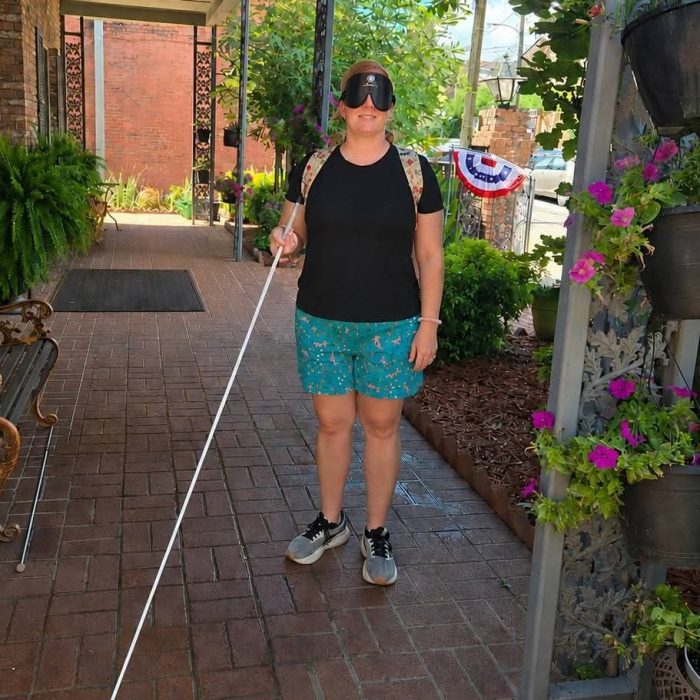
For several days, I traveled with sleepshades and a white cane, learning to gather information
about my environment through touch, hearing, movement, temperature, and spatial awareness
rather than vision.
I learned to identify cardinal directions using the warmth of the sun. I learned to use the sound
of traffic to determine my position within an intersection. I learned to recognize the “crown” of a
street, the slope of a driveway, the feel of railroad tracks beneath my feet, and the echoes
created by buildings and overhangs.
I learned that a fountain drink machine can become a landmark.
I learned that the sound of a friend’s cane can provide reassurance.
I learned that fear can be overwhelming.
There were moments when I became disoriented in parking lots, stuck in concrete corners, and
uncertain about where I was in relation to traffic. The instinct to stop moving was strong.
Yet every day, I became more capable.
The same environment that initially felt intimidating began to make sense. Sounds became
information. Textures became landmarks. Traffic became orientation rather than fear.
That transformation helped me better understand the purpose of Orientation & Mobility
instruction.
O&M is not simply teaching someone how to use a white cane.
It is teaching confidence.
It is teaching problem-solving.
It is teaching independence.
Most importantly, it is teaching people to trust their ability to navigate the world.
The individuals who are blind or visually impaired and travel independently every day are
extraordinary. Their accomplishments are often invisible to others because they have developed
skills that make independence appear effortless.
Organizations such as the Louisiana Center for the Blind dedicate themselves to helping
individuals develop those skills. Through training, mentorship, and high expectations, they
empower people to live independently and confidently.
As an educator, this experience reinforced something I have always believed: our role is not to
create dependence on services. Our role is to provide the tools, instruction, and support that
allow individuals to become as independent as possible.
I left Ruston physically exhausted and thoroughly sunburned.
I also left inspired.
Inspired by the students, adults, instructors, and advocates who demonstrate every day that
limitations are often far smaller than we imagine.
This experience strengthened my commitment to serving students with visual impairments, and
reminded me that independence is not something we give people—it is something we help them
discover within themselves.
~Lindsey J. Treadway